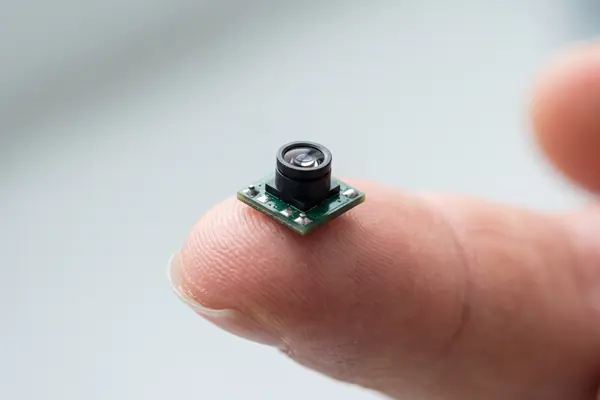
SENSOR SIZE
The 'inch' is a tube size
Sensor names like 1/3-inch come from old video camera tubes. A '1-inch' sensor is about 16 mm across the diagonal, and a 1/3-inch type about 6 mm.
Compare sizes iwatchcamera
00TINY CAMERAS, EXPLAINED

The smallest cameras are mostly physics, squeezed.
A sensor a few millimetres wide, a lens to match and a focus that never moves. Here is how sensor sizes are named, why so much of the picture stays sharp, and where tiny cameras run out of light.
Compare sensor sizes01Principles
02THE SHORT ANSWER
A camera in a watch or phone follows the same optics as any other.
It just has far less room to collect light.
SENSOR SIZE
Sensor names like 1/3-inch come from old video camera tubes. A '1-inch' sensor is about 16 mm across the diagonal, and a 1/3-inch type about 6 mm.
Compare sizesFOCUS
Many tiny cameras use a fixed-focus lens. Set at the hyperfocal distance, it keeps everything from half that distance to the horizon acceptably sharp.
Get sharper shotsHISTORY
A post-war German wristwatch camera took 8 pictures, each 7 mm across, on a film disc 25 mm wide, through a 12.5 mm f/2.8 lens.
Why size matters03A QUICK SIZE CHECK
Pick a sensor type to see its typical size. The bar shows how much light-catching area it has compared with the others.
Typical dimensions; inch-type sizes are not standardised, so real sensors vary a little.
04TWO NUMBERS WORTH KNOWING
One figure on how sensor sizes are named,
one on what small pixels cost in dim light.
≈ 16 mm
Real diagonal of a '1-inch' type
The inch names copy the glass tubes of old video cameras. A 1-inch tube had a light-sensitive area about 16 mm across, so the name is roughly 1.5 times the real diagonal.
THE '1-INCH' SENSOR
≈ 5× lower
Shot-noise signal, small vs large pixels
A typical 2018 phone pixel of 1.1 µm gives about 5 times worse signal-to-noise from shot noise than the 6 µm pixel of a full-frame camera, at similar f-numbers.
PIXEL SIZE
A smaller sensor at the same f-number collects less light in total, which is why tiny cameras show more grain indoors and at night.
05FOUR HABITS FOR TINY CAMERAS
None of these needs extra kit. They follow from how small sensors and fixed-focus lenses behave.
Fixed-focus lenses and small sensors limit performance in poor lighting. Face the subject towards a window or daylight where you can.
A lens set at its hyperfocal distance is sharp from half that distance outwards. Things much closer than that will look soft.
A built-in LED light is weaker than a flash strobe and lights the scene over a longer exposure, so steady hands matter more.
A lens only millimetres wide is easy to cover or smudge with a fingertip. A quick clean with a soft cloth often helps more than any setting.

06WHY NOT JUST MAKE IT BIGGER?
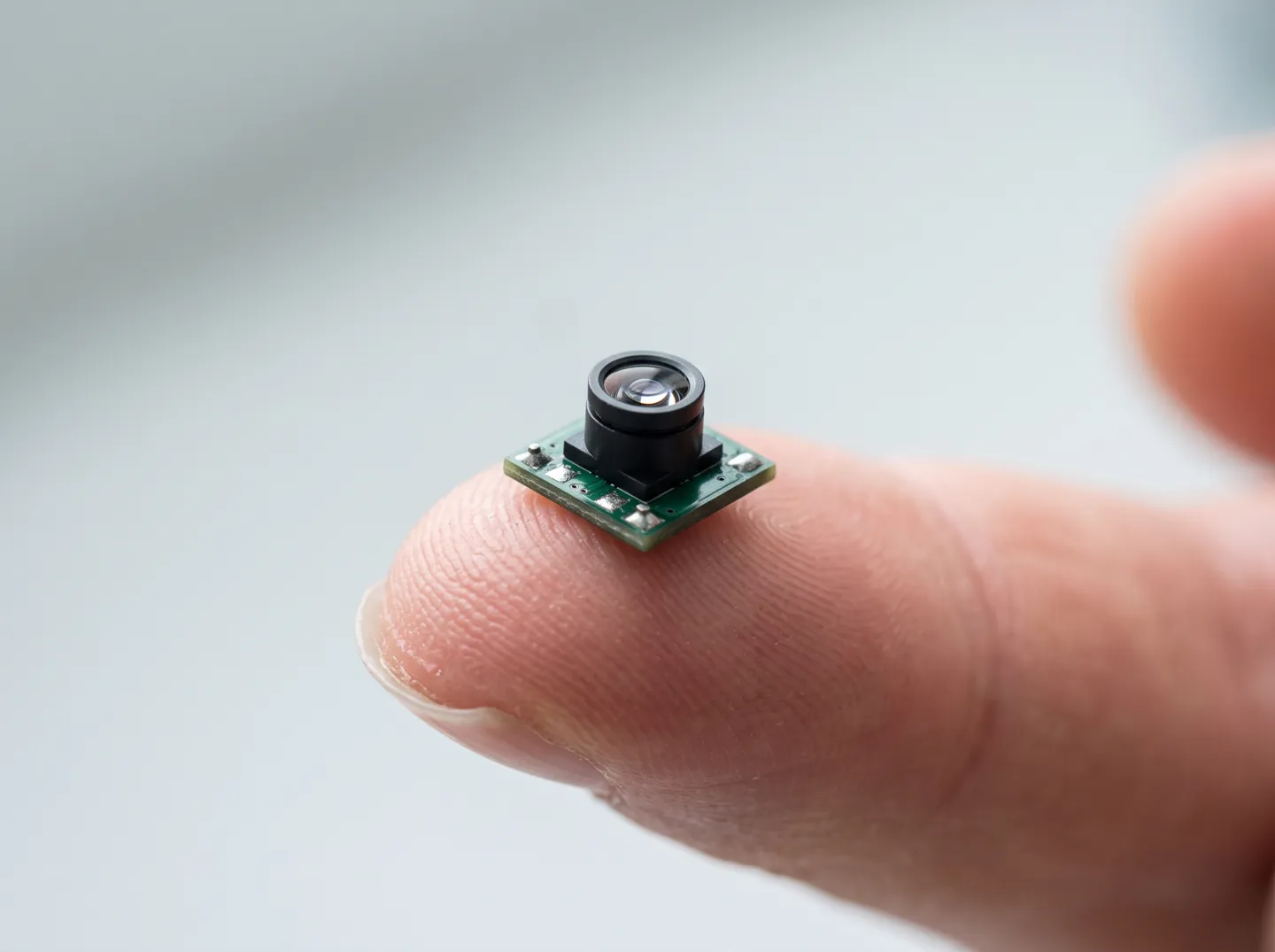
Lens size scales with sensor size. A small body means a small lens, and a small lens means a small sensor, which is why slim phones and wrist devices use sensors only a few millimetres wide.
Makers work around it in software and design. Pixel binning, for example, combines neighbouring pixels so one sensor can capture fine detail in good light and brighter images in low light.
07Questions
The names come from video camera tubes, measured across their glass envelope. The real sensor diagonal is roughly two-thirds of the named size: a 1/3-inch type is about 6 mm across, and a 1-inch type about 16 mm.
Some do, but many small cameras use fixed-focus lenses. The best fixed setting is the hyperfocal distance, which keeps everything from half that distance out to infinity acceptably sharp.
Small sensors have small pixels that catch less light. One comparison found a 1.1 µm phone pixel gives about 5 times worse shot-noise signal-to-noise than a 6 µm full-frame pixel.
Yes. The Science Museum Group holds a post-war German wristwatch camera that took 8 exposures, each 7 mm across, on a 25 mm film disc. The International Spy Museum describes how an agent could take photos while pretending to check the time.
The first commercial phone with a colour camera went on sale in Japan in May 1999. Phone cameras mostly use CMOS sensors because they use much less power than the older CCD type.
08Sources
ABOUT THIS NAME
iwatchcamera.com is part of the DoodleSale portfolio. It isn't in an auction right now, but you can ask about leasing it.